
#HerbalTea #TeaForWellness #HealthBenefitsOfTea #TeaLover#HolisticHealth
Composed by Anuchit Thepsee JIU Wellness co., Ltd.
What is Glutathione?
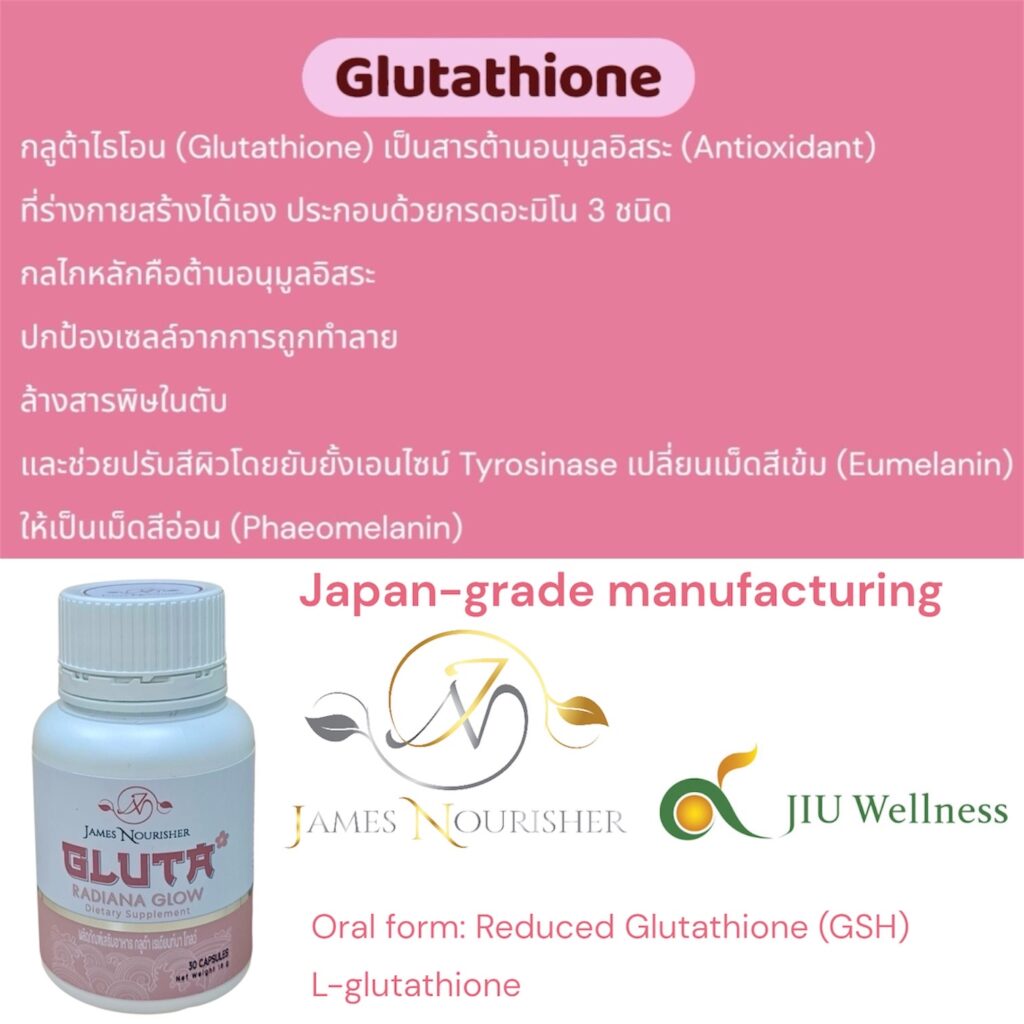
Glutathione (GSH) is a naturally occurring master antioxidant composed of cysteine, glycine, and glutamate. It plays a key role in detoxification and cellular protection against oxidative stress
Therefore, it is called a “master antioxidant” and has become one of the most popular substances in skincare.
Mechanisms on Skin
Glutathione affects the skin through 3 main mechanisms:
Antioxidant → Delays skin aging.
Helps reduce the destructive effects of ROS that cause:
- Wrinkles
- Dark circles
- Collagen degradation
👉 Research has shown that taking glutathione helps reduce oxidative stress and increase GSH levels in the body.
What are ROS? Why do they harm the skin?
ROS (Reactive Oxygen Species) are “free radicals,” or highly unstable molecules, that can be generated from:
- Sunlight (UV)
- Pollution
- Stress
- Body’s own metabolism
How do ROS damage the skin?
ROS “steal electrons” from skin cells, causing a chain reaction of damage:
Increased ROS → Oxidative stress → DNA damage + Collagen degradation → Wrinkles + Dull skin + Premature aging
- Collagen breakdown → loss of elasticity
- Melanocyte stimulation → hyperpigmentation
- Chronic micro-inflammation
Inhibits the tyrosinase enzyme → Reduces melanin production.
Glutathione helps:
- Reduces the activity of tyrosinase (melanin-producing enzyme).
- Changes pigment production from eumelanin (dark color) → pheomelanin (lighter color).
3. Skin Brightening (Not Whitening)
“Bright skin” means:
- Even tone
- Reduced dark spots
- Healthy glow
❌ It’s not “unnaturally pale skin.”
🧬 Mechanism of Glutathione
Oxidative Stress (ROS ↑)
        ↓
 Glutathione (GSH)
        ↓
[Neutralizes ROS]
        ↓
↓ DNA Damage
↓ Collagen Breakdown
↓ Inflammation
        ↓
Healthier, brighter, and more resilient skin
🧬Glutathione and wrinkle reduction.
Glutathione and wrinkle reduction.
- Glutathione 250 mg/day for 12 weeks
- 👉 Helps reduce “wrinkles” and increase skin elasticity.
📌 Mechanism:
- Reduces lipid peroxidation.
- Protects collagen and elastin.
✔ There is clinical trial evidence such as:
- 500 mg/day for 4 weeks
- 👉 Significantly reduces melanin index.
- Systematic review found that
- 👉 Doses of 250–500 mg/day help brighten sun-exposed areas of the skin.
📌 But:
- The results are “gradual”
- not instant whitening.
💊 How many mg should I take? And for how long?
From research:
- 250–500 mg/day → Noticeable skin results
- 4–12 weeks → Begin to see changes
- Long term (3–6 months) → Increased GSH levels in the body
🔎Should I choose Reduced Glutathione or L-Glutathione?
✔ Reduced glutathione (GSH) = the “active” form.
- It contains a thiol (-SH) group that exhibits real antioxidant function.
- This is used in most research.
✔ “L-glutathione”
- It’s the name of the (natural) structure.
- 👉 Generally found in products = reduced form.
📌 In summary:
👉 Choose Reduced L-Glutathione (GSH) for the best results.
⚖️ Comparison: Glutathione vs. Hydroquinone
| Description | Glutathione | Hydroquinone |
|---|---|---|
| mechanism | Antioxidant + inhibits tyrosinase | It directly inhibits tyrosinase. |
| result | Gradually | Quickly |
| safety | Relatively safe. | May cause irritation./ ochronosis |
| Usage | Strengthen from inside | For external use. |
| Expectation | Healthy and radiant skin | Reduces freckles, blemishes, and dark spots. |
📌 Hydroquinone:
- Used to treat melasma.
- But only under the supervision of a doctor.
📌 Glutathione:
- Focus on “overall skin condition” rather than specific areas.
Diagram: Comparing the mechanisms of Glutathione vs. Hydroquinone.
Glutathione (Systemic + Antioxidant)
ROS ↑ → GSH ↓ ROS
        ↓
↓ Tyrosinase activity (indirect)
        ↓
↓ Melanin (Eumelanin → Pheomelanin)
        ↓
Naturally radiant skin
Hydroquinone (Topical + Direct Inhibition)
Tyrosinase enzyme
        ↓(Inhibited by Hydroquinone)
↓ Melanin production
        ↓
Dark spots fade (quickly).
📌 Summary
| mechanism | Glutathione | Hydroquinone |
|---|---|---|
| Anti-ROS | ✔ | ✘ |
| Inhibits melanin production. | Indirectly | Directly |
| Overall skin effect. | Overall | Spots |
Who is it suitable for, especially for Asians?
Asians tend to:
- High melanin content.
- Prone to hyperpigmentation.
👉Glutathione is suitable for:
- People with sun-damaged, dull skin.
- People with dark spots.
- People who want “clear, healthy skin,” not unnaturally white skin.
Glutathione is not just a “skin whitening supplement,”
but a substance that helps:
- Reduces wrinkles
- Protects skin from free radicals
- Balances pigmentation
👉 Suitable for long-term skin care.
👉 Shows results that are “gradual but sustainable”.
References
- Watanabe F, Hashizume E, Chan GP, Kamimura A. Skin-whitening and skin condition-improving effects of topical oxidized glutathione: A double-blind and placebo-controlled clinical trial. J Dermatol. 2014;41(7):653–62.
- Arjinpathana N, Asawanonda P. Glutathione as an oral whitening agent: A randomized, double-blind, placebo-controlled study. J Dermatol Treat. 2012;23(2):97–102.
- Richie JP Jr, Nichenametla S, Neidig W, Calcagnotto A, Haley JS, Schell TD, et al. Randomized controlled trial of oral glutathione supplementation. Eur J Nutr. 2015;54(2):251–63.
- Dilokthornsakul W, Dhippayom T, Dilokthornsakul P. Clinical effects of glutathione on skin: A systematic review. J Dermatolog Treat. 2019;30(4):301–7.
- Briganti S, Camera E, Picardo M. Chemical and instrumental approaches to treat hyperpigmentation. Pigment Cell Res. 2003;16(2):101–10.
- Draelos ZD. Skin lightening preparations and the hydroquinone controversy. Dermatol Ther. 2007;20(5):308–13.
- Valko M, Leibfritz D, Moncol J, Cronin MT, Mazur M, Telser J. Free radicals and antioxidants in normal physiological functions and human disease. Int J Biochem Cell Biol. 2007;39(1):44–84.